
What Does It Take for a Website to Appear in AI Results?
For a website to appear in a search-backed AI answer, the system has to be able to find and read it. The page also needs information that helps answer the person’s question.
For a dog training business, that question might be “Who offers puppy training near me?” or “Would board and train help my dog, and what happens afterward?” Knowing your business name is only part of answering either one.
How an AI answer finds its information
When an AI tool uses web search, it can look up current information and use it in its response. ChatGPT search, for example, can retrieve information and link to its sources. Having a page appear in a search-backed answer is different from having your website included in a model’s training.
A search about puppy training may bring up local trainers, details about their services and explanations of what a puppy owner should expect. The answer can draw on several sources. Your website’s sales pitch may supply only some of the information the person needs.
Google says its AI search features may run several related searches to find supporting information. Each product works differently, though. A mention in ChatGPT doesn’t establish a position in Gemini or Perplexity. And the Gemini app is separate from Google’s AI Overviews and AI Mode.
First, the system has to read the page
A website can look fine to a visitor while a search system has trouble accessing it. The system needs a way to discover the page and read the information. Important details need to be available as text, even when the page also has pictures.
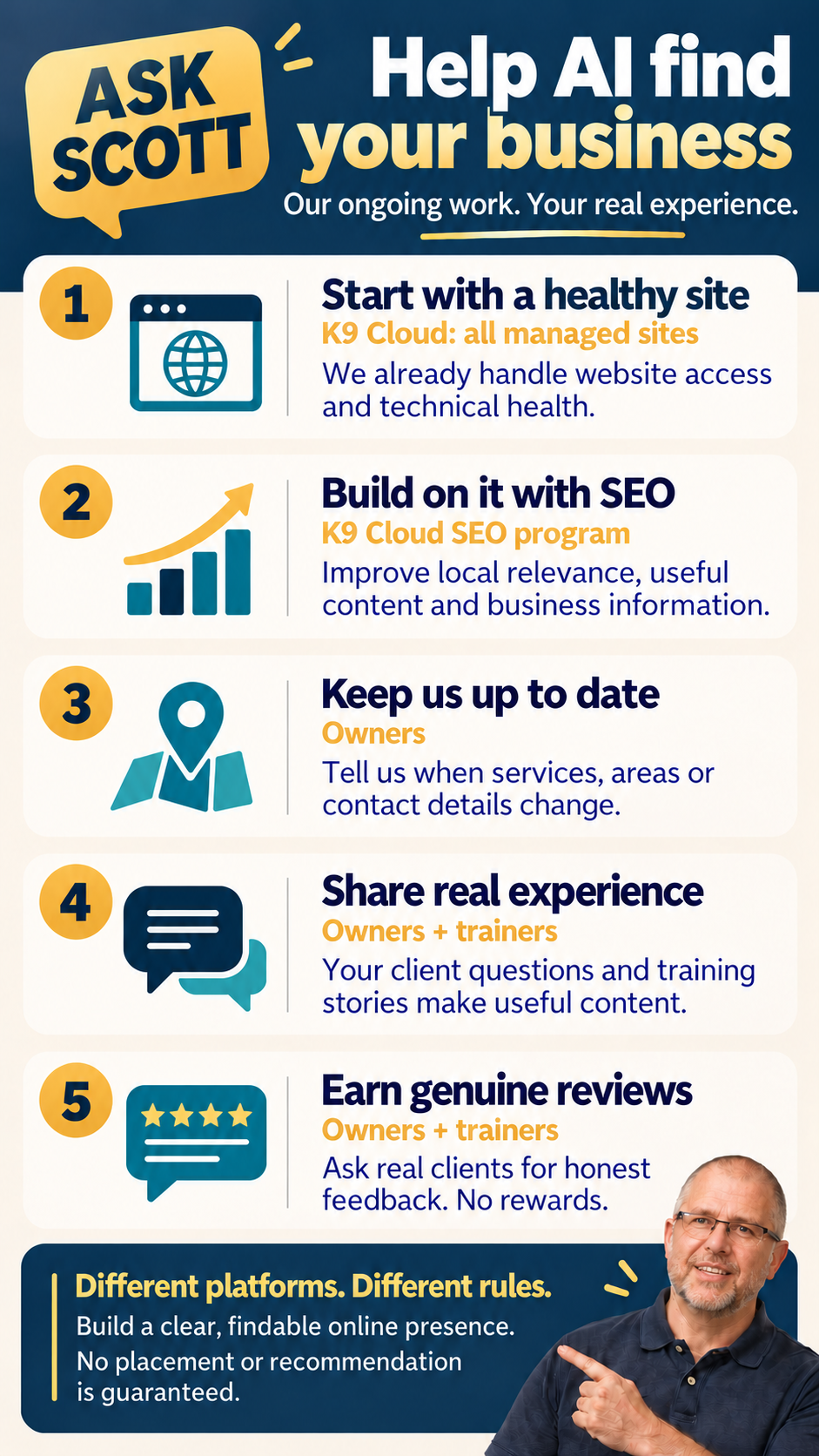
K9 Cloud already handles the website-side foundations for every website we manage, regardless of whether that location is enrolled in our SEO program. Website discovery and access are part of that work. Owners don’t need to request an “AI switch” or arrange a separate technical setup with us.
Once a page is accessible, a search system can consider whether it helps answer the question. Google says a page must be indexed and eligible for an ordinary search snippet to appear as a supporting link in its AI search features. Even a page that meets those requirements isn’t guaranteed to appear.
The question determines what’s relevant
Someone looking for private puppy lessons in your service area needs different information from someone asking what happens after board and train. Your business might suit both people, but the same paragraph won’t necessarily answer both questions.
The local search needs basic facts about what you offer, where you work and how to contact you. The board and train question needs an explanation of the program and the owner’s role afterward. “We offer professional dog training” doesn’t give that person much to go on.
Information outside your website matters too. Gemini can use public Google Maps information, including business websites, ratings and hours. Accurate, consistent details help people recognize the same business across those sources.
When a program or service area changes, the online information needs to reflect the business clients can hire today. Adding the word “AI” to a page doesn’t explain those changes.
Useful explanations draw on real experience
A page explaining a training program can help someone understand whether it suits their dog, what the training involves and what they’ll need to practice at home. A claim that the trainers are excellent leaves those questions open.
The trainers’ experience can make the explanation more useful. A story about a dog that pulled on walks might describe the challenge, the work involved and what the owner learned. “Look at this amazing transformation” leaves the reader guessing about how it happened.
Those details can give prospective clients and search systems more to work with than generic marketing copy. Client permission and privacy still matter, and every story doesn’t need to go online. One dog’s progress also isn’t a promise that every dog will have the same result.
Build credibility the honest way
Your website explains the business from your perspective. Genuine client reviews describe what it was like to work with the trainers, what the client needed and how the experience went.
Google says reviews and links can help local search visibility. That supports paying attention to the business’s reputation beyond its own website. It doesn’t establish a review formula for ChatGPT or Perplexity.
An honest account of a client’s experience can help someone compare trainers. A review count alone can’t explain whether a program fits their dog. Google prohibits incentives for reviews and selectively requesting positive reviews. The credibility has to come from what clients actually experienced.
Where SEO fits
Beyond making the website accessible, SEO is the continuing work of improving how clearly the business is represented and how easily people can discover relevant information through search.
That work applies as search changes. Google says the established SEO fundamentals still apply to its AI search features, with no separate set of special optimizations required.
Our SEO work builds on the website foundations we already handle to strengthen the business’s search presence over time. It can’t purchase a place in an AI response. It also needs accurate business information and real training experience to work with.
What owners and trainers contribute
Your website, business profiles, explanations and client reviews each tell people something about the business. Together, they can help someone understand whether you’re relevant to their search and why they might consider you. None guarantees an AI recommendation.
K9 Cloud handles the website side. Owners and trainers provide the facts and experience we can’t supply for them: accurate updates, the questions clients ask and honest accounts of the work. That information helps the next person searching, whether they find a traditional result or an AI answer.
The next time a prospect asks a question your website doesn’t explain well, save the question and your answer. It gives us something useful to build on.
If you like our content, please add us as a “Preferred Source” to your Google account.